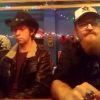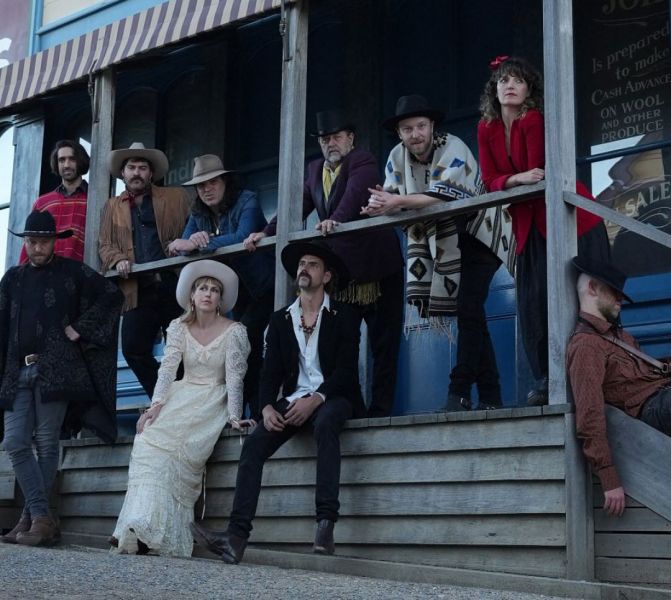
The Counterfeit is a 12-piece Spaghetti Western band out of Melbourne, Australia. While they frequently play different arrangements than the original film scores, their "counterfeit" versions are extremely convincingly mimicing the orignial Spaghetti Western composers, and their off-the-beaten-path song choices had me itching to learn more. So I had a virtual sit-down with Harley Stewart, guitarist and music director for the group, and learned about their detailed plan to bring a mostly forgotten musical genre back to life.
The Counterfeit have Four LPs, two of which are live records, on Fight Night Records. Maybe put one on while you read.
Or you can watch their most recent Live record played in their studio.
Anyway, let's get into it. Anything that looks [like this] is a note I added afterwards.
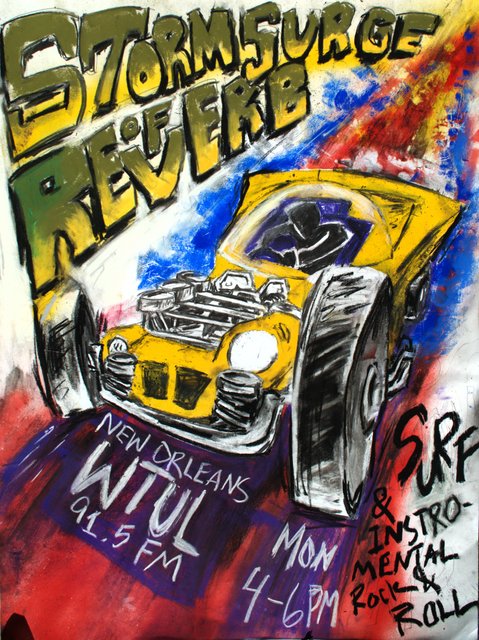
So, I'm Hunter, first of all. I guess I haven't formally introduced myself, but, you know, my whole thing is I do a surf music radio show called Storm Surge of Reverb and also maintain a website. Spaghetti Western obviously isn't surf music, but as you might imagine, there's a lot of crossover there.
Harley: yeah. In fact, that's where I started. It was the surf thing. Surf music like Dick Dale and Link Wray and stuff. And then across into John Barry to like James Bond stuff. And then into the Spaghetti West. That was kind of my progression.
And I suppose from the surf stuff, it started with like Elvis, you know, in the 50s.
Hunter: So yeah, that was kind of the first question I had: just kind of how you got to where you are. So I guess you came through surf music.
Harley: Yeah, or even earlier. I'm a big 50s rock guy. Before I was a Spaghetti Western fanatic, I was and am an Elvis fanatic. And guitarists like Scotty Moore had a real impact on me. And while it's not quite as reverb-y as surf stuff, it's more slapback delays and stuff, nut it's got quite a similar feel. And I feel that's where it kind of started for me musically was with Elvis. You know, like most things. Starting with the King and then working my way forward from there. As I mentioned, it sort of led into Dick Dale and the Deltones and Link Wray and this sort of stuf, your late 50s, early 60s kind of surf, dawn of the surf rock.
And then from there, I was studying -- like I've studied music my whole life. When I went to uni I was trying to find some stuff that was a bit more sophisticated that I could sink my teeth into. And the John Barry soundtracks became a thing for me from James Bond. And more as well, the John Barry 7 and stuff like that. But his stuff is fantastic. He's like an English Morricone for those who don't know him. And he's quite famous for featuring electric guitar in front of an orchestra. Particularly that reverb-y kind of twangy James Bond, like Fender guitar kind of electric sort of thing. And I thought that was super cool, man. And that just sort of kicked it all off in a new way. And from there, it ultimately led into the Spaghetti West where electric guitar is, you know, the hero of so many tracks.
Hunter: Do you remember the first Spaghetti Western album you really sunk your teeth into?
Harley: I think the one that changed my life, you know, obviously, was the Good, the Bad and the Ugly. I was studying over in Italy for a bit and got hella wasted one night. I was in my hotel room with like a couple of bottles of wine and chain smoking some Marlboros, and I put my headphones in and I was like, oh this -- like I'd obviously heard it, but I'd never listened to it like as a body of work, like a full album, you know. And then then my life became quite clear of what I wanted to do musically. And that was about 10 years ago. So, you know, here we are.
It took me a long time to get the counterfeit up and running. We had some other stuff sort of on the go at the time. But it took as long as it needed to take. Unfortunately, too long, though, because Ennio died the year that we started it. So it was quite an iconic sort of thing for me where it was like, you know, it wouldn't have made any difference if he did die or he didn't die, you know, it was just funny that it took so long to do it that he actually died.
Hunter: You didn't happen to catch that farewell tour that he did, did you?
Harley: No, but our trumpeter, Fabian Acuna, who is an amazing, amazing trumpeter and just an all round legendary fella, he drove from Melbourne across to Adelaide, which is a nine hour drive, to see the Morricone farewell tour and arrived just in time.
I think he arrived as he was performing the first song or something, which is totally how Fabian rolls.
Hunter: So I was wondering how this band came to be, and it seems like you had a big plan.
Harley: Yeah, it is a big plan.
I've got a twin brother, Delaney, who you've been chatting with, aka The Sheriff [he was who I originally reached to set this up]. He manages the band and also plays the Fender 6 bass, which I don't know if you're familiar with, that bass guitar. Have you ever heard of that?
Hunter: Yes, but I don't think I fully grasp its significance.
Harley: So what it is, briefly, is Fender made a bass guitar in the 60s for guitar players. Because a lot of guitar players would get pushed over onto the bass guitar, you know, and that kind of thing. So they basically made, which sounds disgusting, but it's not, it's a six-string bass guitar, which anything more than four strings on a bass guitar is an abomination most of the time. But this is different. And it's a six-string bass guitar. The strings are a lot closer together and the strings are a little bit thinner than they are in a bass guitar. But the lowest string is still the same note as the lowest string on a bass guitar, a proper four string bass guitar. So it's in exactly the same register as a bass guitar, but it's an octave underneath the electric guitar.
So basically, it's the famous plucky sound that you hear in Spaghetti West and James Bond and stuff like that as well. Really plucky, you know, like with a plate reverb or a spring reverb on it. You can hear it on tracks of ours like Ranch 'El Senor' or Jerry Theme. It's on all the tracks, but it really features on those. You can really hear that bass just like pinging off. It's really super plucky and a real iconic sound of the genre. It would not be the same without it. A lot of the time you get the Fender six and there will also be a double bass section as well, you know, plucking the bass. So, yeah, the way we started Delaney and I, my twin brother, we sort of got obsessed with this stuff.
And then our compadre on drums, Josh Barber, who's like the meat in the middle of the sandwich, he's the twin mediator. And yeah, so the three of us kind of just got super -- I was already obsessed with it and got these other lads obsessed with it.
And then it kind of started to grow from there. And then we got acoustic guitar and a trumpeter and an organist, and then we've got a pianist, and then we've got a saloon piano player. And then we've got another electric guitar who also plays Farfisa, and then we found a chromatic harmonicist, and a violin.
And we spent like the first, you know, the first year or so... We haven't been together that long, only like two and a half years. And we kind of worked out like the goal was: to reimagine these famous soundtracks, Spaghetti Western soundtracks. And then recreate them with as little instruments as possible. And that was kind of the whole idea. Usually you'll hear on these tracks... you'll hear like a chamber orchestra. That's maybe like somewhere between 20 and 40 musicians. Chamber orchestra is like a small condensed orchestra. So instead of having a whole string section, they might have, you know, a string quartet or two string quartets or something.
So that was the kind of idea. And once we kind of identified the key instruments, which represent personalities and characters, basically --- For instance, the trumpet is the Mexican mariachi. And the nylon acoustic and the trumpet is the Mexican thing. The harmonica is like the European civil war kind of character that has the harmonica in his pocket. Then the whistle is the lonesome cowboy on the trail and so on and so forth.
Hunter: I never put that together, that's really cool.
Harley: And then you've got more, like the Bansuri flute represents the American Indians, and the violin is the European influence and the romantic side of the genre. So, yeah, we kind of worked that out and then settled on the lineup. So, it's basically a bunch of guitars... Oh, and also the Hammond organ is the church, you know, the Bible belt kind of church thing. The pipe organ thing. So it's basically a bunch of guitars, plucky Fender six bass and drums. And then, you know, chromatic harmonica, violin and trumpet.
And when we did the first record, that was the icebreaker, 14 Killer Bullets from the Spaghetti West Vol. 1, We recorded these albums all live to type as a band with minimal overdubs. The overdubs are usually just the man choir and and maybe some bits and bobs. And then after we did the first one -- like we made this first record, which was just super exciting. Like, you know, the band's red hot, man. We just put together some of the best musicians in Melbourne and got really lucky with the way that everybody's personalities click together.
Hunter: How did you find them? Were they people you already knew, were you just putting out ads or what?
Harley: Nah, I mean, we're all studio guys. So I run a studio in Melbourne called Fight Night Records and we do lots of stuff there: we film TV and produce records for bands and whatever. So we've got a pretty like terrifying call list of musicians and we started there. And then, you know... for instance, we've got Jake Mason on Hammond organ. He's just a killer organist. He's got a band called Cookin' on Three Burners, which is kind of like The Bamboos or The Meters, you know, funky. And then he's like, "oh, we should get my mate Chris Maunders on to come and play chromatic harmonica". And I was like, "cool". You know, I can't say I know any other chromatic harmonicists, so I'll give him a call. So we got him and that sort of follows around. So, you know, half the band was strangers to start with, but now we're all thick as thieves.
And we got so lucky with that because it's a lot of people. When you hit the road and tour and stuff like that, you know, the shit can hit the fan pretty quickly personality-wise and clashes and stuff. But we just got really lucky. Everyone's super cool and it works, you know.
So, yeah, that was the first year kind of thing. And we did that record and then we kind of moved from there. We had a session with -- we've got a live studio session, which is kind of like tiny desk concerts, you know, a version of that. And we had this girl in called Freya Josephine Hollick, who's like a cosmic country gal from Ballarat, like an hour away from Melbourne City. And she'd heard of us and she saw the record up on the wall, and she's like, "oh, is that you guys?" And we're like, "yeah". And she goes, "oh, fuck yeah". She's got a filthy mouth on there, that girl. She's like, "oh, if you need a singer, I'm in -- I want to do it." Like, it was like quite forceful with her. I've never heard her sing. And then we did the session and she sounded fantastic. And after the session, we were like, "oh, she's great." She's got this old time kind of Doris Day, old world kind of sound. At the end of the session, I was like, "well, we're playing at Thornberry Theatre in two months, you're up. Come sing, come sing maybe four songs" or whatever. And yeah, we just kind of kept moving from there. That was it. Once she was in, she was in.
Like... we sort of had ideas of changing the vocalist all the time.
Hunter: I was wondering about that. Some of these songs have such a burly male attitude to it, and I think she does a great job on them. I don't want to mention which ones because I want to talk about them specifically later, but I was surprised how well she mixed in. My wife listens to a lot of these spaghetti western songs too, and when I played it for her she was like "Oh wow, she's doing it!"
Harley: She's the real deal, yeah! And I mean, it's sort of became clear... the original idea was to get a female vocalist, but we just couldn't find the person. But it'll always be an instrumental band with a singer.
Hunter: You know that's also something I think about -- I think about the Django theme a lot. I love the vocal version of that, and I'd heard that version way before I got the album, and then I heard the instrumental version, and that gave me chills.
Harley: You're talking the Louis Bacalov, the original one?
Hunter: Yeah
Harley: Yeah that instrumental version is sensational. So much so, that was the first version that we recorded was the instrumental version. And yeah, I dig it, man. I really dig it. And Rocky Robertson [vocalist on Django}, unfortunately, I'm yet to find anything else good from Rocky Robertson. Like, I've dug in the darkest corners of Spotify of Rocky Robertson, but I just haven't found anything else that's even in the same league as his work on Django.
Hunter: There's one pop song that I like, but it's name is in Italian and I've totally forgotten it, but yeah. [It's Stasero mi Bunto, but listening again I shouldn't even mention it in the same breath as Django]
Harley: But yeah, I mean, as far as the female vocalist goes... for us, you know, I don't know how it is over in the States at the moment, but in Australia there's a lot of equal rights stuff going on. A lot of reconciliation going on with white and black Australia.
Hunter: Sadly, we're going in the opposite direction right now, but anyway...
Harley: Yeah. Well, it's taken us long enough. But on a gender front, gender equality thing's been a big thing in Australia for the last five years, maybe more. And with the genre... not that I think about this stuff too much, but in terms of what I'm about to talk about, it's such a male-dominant genre, the Spaghetti Western. You know, it's a testosterone-fueled genre. And some of the shit that happens in those movies is... you just can't get away with that shit anymore. I mean, it's just so wrong on so many levels. I mean, I still dig the movies and stuff, but it's funny --- and I'm not one of those people that's like "oh,you can't say that anymore, so take it down" -- it's not like that. We're talking about the 60s, it's a long time ago, society changes, trends change. You know, we can only look back and kind of be somewhat amused at how primitive some things were back then. You know what I mean? And particularly on an equality front.
So anyways, my point is that putting a female fronting this band of 12 people with basically 10 blokes (our violinist is female) fronting that band -- that male-dominant band with a beautiful blonde country girl spins the whole genre on its head in such a marvelous way. And just having a female protagonist... we're writing this originals album at the moment. The protagonist is a female, right? And the way that we've done that, I think, is quite masterful in the way, as I mentioned, it spins the genre on its head. And it kind of breathes a whole breath of fresh air into this genre. You know what I mean? And I think that's super exciting. And it hasn't been done. I mean, yeah, there's some female characters in some of those movies. But there's never a protagonist. Not that I know of, at least. I mean, maybe you know.
Hunter: Oh, I don't know the movies as well as the music.
Harley: Same here.
Hunter: You probably outclass me in both anyway
Harley: Well maybe not the movies. Don't tell anyone [oh no, I told], but I haven't watched a lot of them. I need to watch more of them, yeah.
Hunter: I was wondering that, though. Because, yeah, they're more separate than they should be for me.
Harley: But yeah, anyway, I think it's a cool thing [referring to female inclusion in the band], And it looks great with a band. And the way that we set up on stage is like the Western arc. So it's like a horseshoe sort of thing. And she stands in the front and then leaves when she's not playing. And we stick in our kind of horseshoe shape. So it just looks fantastic as well from a visual perspective, having, like, some pretty badass-looking dudes in ponchos and ten-gallon hats and shit like that. And then this beautiful blonde girl, and she wears these old kind of frocks, I would call them, like these old-time kind of dresses. And she's got sort of the Amy Winehouse tattoos and the big hat. And she's just – she's a star, I reckon. She's a star. And I'm so glad to have met her and I'm really excited to watch her keep growing as a singer.
Like, dude, those songs are hard to sing.
Hunter: Oh, yeah.
Harley: Like we have to change the key signatures for them to fit. Because if you play it in the wrong key for the singer, because the range of the melody is so wide -- for instance, it hits the lowest note of a register and often the highest note of a register. For instance, in something like "Django", the outro of "Django", when Rocky Robertson or Freya is singing those high notes, that's the ceiling of the melody. But then you've got [speaking low-pitched] "Django", and it hits those low verses at the start.
Hunter: That's why I was so surprised to hear a woman do it, because I feel like it's like exercising that male low, you know? It's showing it off.
Harley: Totally, yeah. So, yeah, I'm really – she's just grown and grown as a singer and got better and better since she started singing with The Counterfeit. And that's why she became the singer, because she works hard, and she's great to hang out with, and she can hold an audience.
Hunter: Uh-huh. You know, I don't know anything about her solo, so I should have looked that up before I did this whole thing, but I'll do that later. Yeah. I enjoy a little cosmic country.
So, in that whole thing, you answered a bunch of my questions about a lot of things, including -- I think it's interesting that you're not doing straight versions of these songs. Especially – I feel like the more well-known the song is, the more you're messing with it.
Harley: Yeah, that's the idea.
Hunter: And it's also funny because I think about how certain versions that you hear aren't like the versions. Like, I like this album [holds up an album, nerdily], do you know this one?
Harley: Leroy Holmes? I do. Yeah, man, I love that. We just did a version of his version of – well, similar to his version of Goodbye Colonel. We put out a live record a couple of weeks ago, which is video record too, called Live at Fight Night Records Volume 2, and it's that Leroy Holmes version of "Goodbye Colonel" that is the opening to the record.
Hunter: I think.... there are so many different versions, you know, so why would you only play the version, you know?
Harley: Yeah. I'll recommend -- Leroy Holmes and his orchestra do a bunch of James Bond stuff as well, and it's fucking cool, man.
Hunter: Oh I haven't heard that!
Harley: Yeah. Look it up on YouTube. I can only find it on YouTube, but, yeah, from Russia with Love and Goldfinger with like electric guitar playing a melody. Dude, it's super cool. But, yeah, that's the idea. We sort of – some of them we play quite similarly, but others, the more famous ones, ....it's a case-by-case scenario, but we try and do different stuff. There's another guy who's influenced us a lot called Hugo Montenegro. His take on the Morricone stuff is probably my favorite, to be honest. He's awesome.
Hunter: I feel like I actually find his version of Good, Bad & Ugly more often than Morricone's version, just when I'm out digging at thrift stores, et cetera.
Harley: Yeah, he's got that cool record with the orange and black writing on the top and like a sketch of like a cowboy sort of thing, but it's got...
Hunter: Got it right in the other room!
Harley: You've got that, yeah? I've got a copy, but it's Cactus. It's a bit kissy and a bit funny, but it works alright, but I need to find a better copy of it. But yeah, they've been a great influence.
So I guess at the moment we're moving forward. We're basically working on... We've entered phase three of our kind of master plan of world domination.
Hunter: Yeah, you know, I had like all these questions prepared and then like two hours before I talked to you, I looked at your page on Fight Night Records and at the very end, in the "what's next" section, I'm like, whoa, this is a whole other interview.
Harley: Yeah, totally. Like an important thing to talk about, I reckon, is original music because that's where it's at for us and that's always been where it's at. However, even if we were a famous original Spaghetti Western band, we would still play Spaghetti Western covers because... And that's why the show is doing so well in Australia is because people come along and we play like 22 songs, right? More or less. And I reckon people only know 30% of them. So "Fistful of Dollars", "A Few Dollars More", the "GBU" [The Good, The Bad and The Ugly], "Django", some other rare ones, maybe "Arizona Colt" or something if there's a couple of fanatics in the audience, but the majority really don't know anything.
So more or less... It might as well be original music because... I mean, it's not, but people have never heard it. Nobody's heard this shit before, you know what I mean? Even the fanatics, there's always stuff that you haven't heard. And guys like you and I who dig through the crates and find all this stuff and put it in a playlist or whatever it is, there's just so much... And I just keep finding more stuff and meeting people like yourself who send me stuff and I'm like, fuck, this is awesome.
Hunter: Yeah, I was wondering, do you feel like you're approaching the bottom of the barrel? With surf music, I find the more that I learn about surf music, the more I learn what I don't know is kind of how it works for me.
Harley: Yeah, the old Dunning-Kruger effect. I find there's been moments where I was like, "Alright, I've hit the bottom of the barrel here. We're scraping the bottom of the fucking barrel." But then I'll meet somebody and they'll send me this Dropbox holy grail full of all this shit that's not on Spotify. And then I find this other stuff and it just keeps going. And now I'm kind of going through YouTube because there's all this stuff on YouTube that's not on Spotify. So yeah, I feel like I'm kind of finding stuff and when the end is nigh, another door opens up and there it is again.
But back to my point, which was that the shows feel... I don't think it's a tribute show. We don't call it a tribute show. It's more like a concept show. And the reason why it's different to like an Elvis Presley show or something like that is for starters, nobody knows who these musicians are, who were playing the original soundtracks. It's not like some famous face that's put in front of it all. They're all mystery musicians. Even I can't work out who the musicians are.o that's why it's kind of like a concept show and people don't know 60% of the music. And that's another big thing. And we've got the projector behind us with (more or less) the scene that the track is derived from.
But yeah, anyways, for our grandmaster plan, we're in phase three at the moment. And this has always been leading towards original music and composing original stuff. And the reason why we didn't start doing originals first was firstly, I didn't know the genre. I mean, I did and I could have done a half-cocked version of it. And it would have been cool. But I didn't want to do that. I wanted to learn it and use this as a vehicle to feed my desires musically. And so that was a big thing. Second thing was who the fuck's going to buy original Spaghetti Western record when they've no idea who it is? You know what I mean? There was that factor as well.
Hunter: Besides me, but point taken.
Harley: Yeah, me too. Besides you and I. So what we decided to do was like, okay, let's do this concept show. We use the Morricone name to market. Everybody knows Morricone and as soon as you slap his name on it, you sell tickets. So let's do that. Wake up all these Spaghetti Western fans who have gone dormant since the mid seventies and get them all and get this community together and get everyone, wake them up, shake them up, wake them up, which is exactly what we did.
We sold out our first show. It was 400 tickets. I couldn't believe it. 50 buck tickets. In fact, all the shows, there's been like two or three regional shows which haven't sold out and everything else has sold out and we've done a shitload of gigs. Every gig sells out. We're playing a big gig in Melbourne in four weeks and we've got probably about 600 capacity and we've got 50 tickets left and there's a month to go. It's a dream. It's a dream. I just can't believe it.
So anyways, I appear to have woken these fans up. Now over the last six months or the last year, we've been working on this originals record and we're now starting to slot these originals into the set among tracks that people cover songs that people don't know anyway. Like "Aces High" and you know, "Rancho Senor" and "Find a Man" and "The Grand Massacre" and shit like that. And "My Fault" is another one of my favourites, the Morricone one. And now we're starting to fill the set with originals.
So this next gig will be the most originals we play, and there'll be six. So it'll be three instrumentals and three vocals.
Hunter: Well, you passed the Turing test for me because I listened to that most recent record, Fight Night Volume 2 and I heard "Hurricane Lilah" and I looked it up thinking, "what is this from?" And then I realized it's not from anything!
Harley: That's awesome. Yeah. Listen to the studio version of that. It's sensational. And also there's a saloon piano version.
Hunter: *laughing* I don't love the saloon tracks on Spaghetti Western records. But it's a part of the genre. If you don't have them on there, it's cheating.
Harley: Yeah, it's part of the genre. You know, sometimes they are cool, but a lot of times like these kind of like comical sort of saloon piano tracks... if you dig .... and I've started a bit of a playlist of saloon stuff and it's more about the stride piano genre. And it's cool. It's a cool thing. And I actually live in Mexico and I'm a big Mariachi fan. I live in Guadalajara, which is the city of Mariachi and tequila. And so there's Mariachis everywhere. And I've become quite a fanatic of that. I'm even like having some like guitar lessons, like learning the technique and I'm really into it. And I've learned a lot about trumpet, like arranging for trumpet and violin through the Mariachi stuff. Anyways, we've got this guy called John McCall, or Johnny Royale is his stage name. And he's the oldest guy in the band. He'd be in his mid in his early sixties, perhaps. And he is a brilliant, probably the best in Australia at stride piano. Like he's just fucking dynamite, bro.
There's a track on 14 Killer Bullets Vol. 2 called "Aces High". We did the version on volume one, which is the band version. Then we did a saloon version on volume two, but he's fantastic. In fact, he does the intermission at shows. So he comes out and he's like Johnny Royale. And he's got this little villain hat on and he's in a sharp suit and does this sick stuff. But I've been feeding him famous Mariachi songs to do like stride piano versions of in the intermission. So that's working quite cool as well.
But yeah, so that was the kind of the whole thing in terms of the plan was to firstly wake everybody up and get all the fans in the one room together. And then secondly, to learn how to do this genre: how to compose, how to arrange, get the instrumentation right and learn it. So ultimately when we started writing originals, we'd have done so much of this stuff to the point where anything I write now comes out like that, you know what I mean? Like, even if I'm writing a pop track with some singer, it's all in there now. Like we wanted to do so much of it that everything we did, every time we compose something, it would, whether it's, you know, recognizable or not, whether it's disguised, it would sound like that.
And that's exactly what we did. And so we we decided to write this album, which is called Violent Night on the Prairie. The soundtrack to a film that will never exist. So we've got characters, we've got a whole story, and it's basically Hurricane Lilah is the protagonist, and it's a vengeance story (as they all are, mostly). And now to write this stuff, it's easy, you know what I mean? Like it's just, it's so normal and so organic and natural that, you know, it's exciting and the record's sounding fantastic. I'll send you some, some sort of sample early bird, like a bit of a sneak peek for some stuff as well.
Hunter: Oh goodie!
Harley: And yeah, we're really, really looking forward to putting that out. And I think that'll be the, this kind of game changer of the band that solidifies that we can do it. Cause it was a bit nerve wracking to be honest. It's like, fuck, can we even do this? And when we wrote Hurricane Lila and we're like, "yeah, totally, totally massive".
Hunter: And so there's a tour in the works, like a world tour.
Harley: Yeah, we probably fluffed it up a bit, calling it a world tour, but it will be.
Hunter: I don't think that's the wording you used here, but you listed four different nations. So that counts in my book.
Harley: I mean, we've got a saying in the band that all roads lead to Rome. So, you know, when we get to perform in Rome, that's a huge success for us. I mean, that's the ultimate thing. And I, and I would say that's a last perhaps, I mean beggars can't be choosers, but in a perfect world, you would do that last and you would do it the best since that's where it all starts.
But the Japanese go nuts for spaghetti Westerns, they call them macaroni Westerns over there. So, and there's, you know, a big population over there, and it's quite accessible from Australia. Good cheap flights and, and the currency is good. We get a good bang for our buck in Japan, whereas we come to the States and get fisted by the American dollar as fuck.
But yeah, so Italy and Japan, I think, are really obvious ones. And obviously America. I feel like Las Vegas is the place to start and do like a concept show, you know, a residency in Vegas somewhere and funded a tour, a West coast tour, maybe to start with, cause it's close to Australia. Do that first. And then, you know, obviously Nashville and Austin and places like that would be quite good. Anywhere where there's country music, which is funny cause I don't even really like country music now. I mean, I'm starting to like it now more and I'm starting to get it. And there's a big resurgence of country music in Australia, but if you had asked me even five years ago that we got nominated for best country album for "14 Killer Bullets Volume Two" [by the Music Victoria Awards], if you had told me that we were getting nominated for best country album, I would have laughed in your face. Like, I just think that's hilarious.
Hunter: Yeah, I can imagine them saying "Well, I don't know where else to put them, so Country Music it is."
Harley: And yeah, that's it. Well, it's funny, you know, I don't know if you've thought of it like this, but when an Italian listens to American country music, and I suppose that would have been back then, they would have been listening to like, you know, Johnny Cash, Merle Haggard, Hank Williams Jr., all that sort of stuff. The Italians hear that, then they go and write their version of the country song, which is "Django". So "Django" is a country song, but it's just done in an Italian way. Which is quite funny. They're Italian country songs, you know, like stuff like, particularly the vocal stuff like "Angel Face" and "They Call Me Trinity". "Find a Place to Die", you know that one?
Hunter: Only because you played it.
Harley: Yeah, that is such a fucking great track. I'm so into that. But yeah, that's what you get when you get an Italian composer that listens to American country music, they write country songs that sound like "Django".
Hunter: Yeah, I never thought of it that way. That's really cool.
Harley: So anyway, ultimately, you know, the tour then goes down to Mexico, obviously, as well, because I live here.
Hunter: You know, it makes sense. From what I understand, in the surf scene, Mexico goes nuts for surf music. Like they have a big surf music festival. It's honestly bigger than any of the ones we have in the US. And like, they sell out.
Harley: Where's that?
Hunter: I think they just supposedly had their last one. Wild O Fest. I think it's just in Mexico City. Bands that have played it have said it's been their biggest show.
Harley: Send us a link.
Hunter: Will do. But yeah, as we've been saying, I think there's, if there's an affinity for surf music, there's probably an affinity for spaghetti western music. There's some Spaghetti Western artists from Mexico... Oh, yeah. That actually leads into a question: Do you follow many other modern spaghetti western groups?
Harley: I don't really know any. I know like a couple of people, a couple of bands that have done sort of cameo. Like, I mean, my mate's from a big Australian band called Jet. I don't know if you've heard of them. They sing, "Are You Gonna Be My Girl?" With the Iggy Pop kind of riff.
Hunter: Oh yeah Jet! Yeah, that was like a bigger band than I was expecting. So that's why I took a second. I was like, that Jet?
Harley: Yeah. Well, the singer from Jet, his name's Nick and his old man was Italian. So he spent a lot of time over there and him and I hit it off recently. And his mate wants to introduce us to this Italian band called, I think they're called Calibro 45. Yeah. 45 caliber.
Hunter: Calibro 35. Yeah. They've moved in a more sort of, like library direciton. They've sort of shed Spaghetti Western a while ago, but yeah.
Harley: Oh, is that it, cause I listened to them the other day and I was like, "this isn't very Spaghetti West".
Hunter: Yeah, I think the earlier albums. I just bought their new one though, like a month ago it's still good.
[they did also did two Morricone tribute records in 2022: 1 and 2]
Harley: The other band is, do you know King Gizzard and the Lizard Wizard?
Hunter: Oh yeah, of course.
Harley: They're from outside of Melbourne. They're the hardest working band in Australia.
Hunter: Oh I don't know how they do what they do. Like they put out like 4 LPs in a year.
Harley: Well, they've got studio. And they've got spin-off projects. Have you heard The Murlocs?
Hunter: Yeah. A little bit. Yeah.
Harley: Listen to it, you'll like it. It's quite surfy. It's like, it's a psyche sort of surf 13th Floor Elevators kind of vibe. I'll send you some stuff. But they did a record a few years ago called Eyes Like the Sky. It's got a voiceover narrative and it's about this white boy that's like an orphan and his people get killed on the trail and, and the Indians take him in and they name him "eyes like the sky" cause he's got blue eyes.
I mean, I like new sounding shit as well. And, and particularly I liked the Lana Del Rey, the way that she and that producer -- who I think is English -- did the Spaghetti Western kind of sound on the record Born to Die. Well, not Spaghetti Western, but they had like a Western themed kind of pop thing, which I really dig. But some stuff, um, I don't like people fucking with it too much.
Hunter: Yeah. I hear you. I mean, even though I'm aware of a bunch of groups, I don't know too many that.... I mean, even though you're doing different versions of these songs, it still sounds like it could be like alternate universe versions. I don't know too many bands that do it quite like that, or at least that accurately, you know, maybe they're going for it and they don't quite hit the mark. And of course I know plenty of bands of surf bands.... there's sort of a surf sub genre that I call Super Spaghetti where it's very like fast paced, almost like two times speed Spaghetti Western. It's like Spaghetti Western punk.
Harley: I like the cinematic country kind of thing. Like that has spaghetti Western elements. Do you know Charley Crockett?
Hunter: No, I don't.
Harley: I think he's Texan. He's blowing up a bit at the moment. He toured with like Leon bridges and stuff, he's fucking cool. In fact, he's got me into country music. He's just an excellent storyteller and he's got a great voice and a band. And he's got a couple of tracks that are produced in a cinematic Western kind of way, which is quite exciting. But they're always just like cameo track though. It's important to know that there's a big difference between the American -- the soundtracks of the American West and the soundtracks of the Italian West. Like the American West is more romantic, symphonic sounds. Traditionally speaking, more modern, it's more in a blue grass, yellowstone kind of picking guitar, acoustic guitar picking kind of realm. But traditionally those American Western TV shows and, and stuff like Lonesome Dove (and I love that fantastic show), they're quite symphonic and more string based, not really electric guitars.
Italians are just... they've just done it differently. You know what I mean? I think the funniest thing is this whole thing, which you'll appreciate being an American, is when you think of the American West and the soundtrack that goes with that, it was created or pioneered by Italians. It's just a funny thing that makes you smile. And there's so much Western media before they did that.
Hunter: Yeah, America had established their own version of the West and then the Italians just crashed it.
Harley: Yeah. they did a bastardized version of it, but it was actually better.
And it wasn't just better than, than American Western soundtracks. It was better than all soundtracks, you know, the majority of soundtracks. These guys like Morricone and Francesco (Francesco De Masi is one of my favorites) and Louis Bacalov and these types of cats, they changed film music forever, man. Like it wasn't just in a Western movies, like the way they shaped composers like Hans Zimmer and people like that. You know, Hans Zimmer, I saw a thing the other day, like that new(ish) Ennio doc, have you seen that?
Hunter: I've been meaning to. I haven't sat down and done it.
Harley: Man, check it out. It's awesome. It's long, but it's awesome. But yeah, Hans Zimmer in that, he was young, you know, and Morricone shaped him, taught him so much. Not personally, but just from Hans Zimmer listening to his, to his soundtracks and stuff.
And Morricone was... well, he's the most famous and he's probably the best, although I don't like to put music in best and worst piles. He's certainly at the top and he certainly was one of the key pioneers of the sound. But it's also important to realize that also it's is that the sound of his records and the way they're recorded and mixed sound was the best, in my opinion, most of the time. And also the movies that he did were the most famous. Therefore he's the most famous spaghetti Western composer.
Hunter: Yeah, this is a tangent, but I frequently think that a lot of the movies that we think of as great classics... I think we don't give soundtracks enough credit. Like, like when you think of a lot of the big blockbusters, like, wow, they all have an amazing soundtrack. Maybe it's not a coincidence, you know. A soundtrack stirs us, makes us feel more about the movie.
Harley: You know, I couldn't agree with you more. Like I think they go hand in hand and so much. So by the time that Leone was filming The Good, The Bad and The Ugly, which is the third one, the soundtrack was already done before they filmed it. And those actors were acting with the fucking soundtrack playing on set.
Hunter: I didn't know that!
Harley: Yeah. It's super cool. Another fun fact, in the Dollars trilogy, every scene, Clint Eastwood has a stogie hanging out in his mouth. I read the other week that he absolutely hated smoking so much so that he almost didn't do For a Few Dollars More because of the smoking.
Hunter: That's amazing.
Harley: But yeah, it's a beautiful thing. I just think that these soundtracks... they are not just the greatest Western soundtracks, but some of the greatest soundtracks of all time, and they resonate with people, whether they like it or not, you know what I mean? I feel like when we started this band, half the people you'll ask "do you like spaghetti western soundtracks?" And they're like, "what the fuck are spaghetti western soundtracks?" But the other half are like, "yeah, I love it." But they don't think about it and they don't listen to it. It's this genre that has been left out on the trail back in the 70s, and kind of got lost. Besides the super famous ones, the obvious ones. And that's where we come in. And I just want to play a hand in bringing in this great genre of music and getting as many people to hear it as possible, because I reckon that's it's some of the greatest music that's ever been composed, and played and performed. And I just want to share that with people, because I know that the majority of people have a soft spot for the spaghetti western soundtracks. But they've just forgotten about it. And that's why we're here.
Hunter: As far as revival goes, y'all are doing a great job. But it is a high bar, you know.
Harley: It's terrifying. Some of those pieces are terrifying, dude. Like, to play. Some specific ones that are terrifying to play: Although it's not a Spaghetti Western one, the Morricone one, "The Sicilian Clan". That's a terrifying piece to perform. And as Morricone says in his doco, which I watched the other week, it was nice to hear him, the composer, validate this for us. He said it was the hardest score that he ever did, the most intricate collection of parts that he'd ever worked on. And you can feel that when you play it. You really need to focus when you play that song, because if you don't, it'll be a train wreck.
And the other songs, we close every gig with The Trio, which is the final shootout scene for The Good, The Bad, and The Ugly. And it's got those big guitar cadenza bits. Terrifying. You know, particularly playing at a big festival or stuff, it's just electric guitar for like minutes, you know what I mean? And the audience is just like, I don't know what hit them.
Hunter: Are there any that had you thinking "Can't do it?"
Harley: The one that we thought was untouchable was "The Arena" or "La Arena" from The Mercenary. It's the one that goes... Oh fuck. I don't have my guitar here. It's got this whistling intro.... it's a Morricone piece and Morricone's whistler, who was Alessandro Alessandroni, who was also an acoustic guitarist, he whistles at the start of that piece And we're just about to put out a live video of us doing it at this big church gig that we did in Melbourne. It's got a big white stained glass church windows sort of behind as the backdrop to the stage. It's quite cool. But the whistling intro for that is just the most angelic sublime whistling that you will ever hear in your life. It is just the most pure, perfect whistle. And it's a very complex part. And it kind of does these big slides, it's awesome. So we were always like, "oh no, we can't do that" because you can't do it! But then we found our acoustic guitarist and I rang him for the first gig. We didn't do that song till quite recently. We were warming into it, but we found this acoustic guitarist, my old mate. And I rang him and I told him about this thing, The Counterfeit, and come and make the first record. And he was like, "fuck yeah, I'm in. That's awesome." And then at the end of the phone call, he was like, "oh, by the way, I'm an excellent whistler as well." And he starts going and busts out this... I was just like, holy shit, he whistles with power. And he's got this excellent vibrato. And then after that, I was like, maybe we could do The Arena. \
Hunter: I love that it's your acoustic guitarist too. What a mirror to Alessandroni.
Harley: It was just bizarre. It was bizarre. And it really worked out. So yeah, to answer your question, there's none that I came across. There was one... And there's another one by Bruno Nicolai called "Burn Them Alive". And it's called Vivo in Bruciatelli or something. I can't remember the Italian. It's got this "The Good, The Bad, The Ugly" guitar line. Well, that's a pretty fierce guitar line. All the Italian composers would have listened to that and gone, "that's why Ennio is the best". But Ennio would have listened to Bruno Nicolai's guitar line in "Burn Them Alive", which is sensational. And he would have gone, fuck, he's beaten me. But it does this super quick all the way up the neck thing. And, you know, I'm not a fast guitar player. Like I'm not really, it's not really my vibe, I'm more of a tone guy, a note choice guy. But I worked on that and I kept practicing. I worked it, I worked it, I worked it and I got it. And we've been playing it recently and it's been great. And I love that track. I just think it is the number one Spaghetti Western electric guitar line in the whole genre that I found, followed by The Good, The Bad and The Ugly.
Hunter: Can I ask you some very quick ones?
Harley: Let's do it.
Hunter: I saw you've done a set of James Bond music. Do you think you're going to record that at some point or is it just like a fun little thing you do every once in a while?
Harley: I reckon we will.I reckon we will for sure. Yeah. I'm not sure when, but we most certainly will. Originally the counterfeit was first set Spaghetti Western, second set spy music. But then we realized the potential of both of those projects and separated them.
[I'm going to edit a bit here because this is so long, but I had a little geek out about the fact that they do two songs from the Day of Anger soundtrack. And then I wanted to talk about "Find A Man"]
Harley: Yeah. That was a hard one to do. That was particularly hard for Freya, but she sang it well.
Hunter: Well, the rhythm of it is really tough. Because I try to sing along to it. It's difficult.
Harley: Yeah. And it's a great instrumental and a great arrangement. I really, really dig the arrangement of that. And I learned a lot of about the arrangement of that song, in fact, with models or template of the arrangement with one of our new originals, "Violet Night on the Prairie". It's got that same sort of thing, it's sort of like a verse and then a bridge. It's like a verse, a chorus and a verse and a mini chorus kind of thing after the bridge, it returns to "find a man who never kills and love him till he dies" or whatever it is.
And the guitar -- Francesco Di Masi, who's probably my favorite Italian Western composer, probably before Morricone.
Hunter: I was going to ask you what your two favorites were. Because I was expecting Morricone to be token number one.
Harley: No, Francesco De Masi is the man. So, I reckon he might've been a guitar player because a lot of his stuff is very guitar and Fender six bass driven. And for my twin brother and I, they're both our instruments. So we really gravitated towards his stuff. And then obviously Morricone is the maestro. So I would say those two.
But that song, the acoustic, the 12 string acoustic guitar, which is quite an iconic element to the sound of the genre is Alessandro Alessandroni. So Francesco Di Masi and Alessandro must've teamed up for [this soundtrack]. And, and that line is just so cool. And I fell in love with that part to play on the 12 string
[we chatted a bit more about specific Spaghetti records that don't translate to well to transcription here]
Harley: I think Morricone's best sounding spaghetti Western soundtrack is Once Upon a Time in the West. That was his favorite. I think that's the most detailed and the most thematic, and he'd really honed his skills by that point. I mean The Good, The Bad, The Ugly's up there as well, but he did Once Upon a Time in the West with Leone after all those and it's a lot more consolidated. I think he established the sound of the West by that point, and it's a great movie.
There's a track we do... We've been doing a great version of "The Grand Massacre", a medley of "My Fault", which is from both Morricone ones -- "The Grand Massacre" from Once Upon a Time in the West and "My Fault" from My Name is Trinity. But that " Grand Massacre" from Once Upon a Time in the West, that is a fucking awesome composition. I love that so much. I just think it's sensational, I think that's some of his finest work and that some of the finest composing film composing that's ever happened. I just think it's five star, it's a five star soundtrack. There's even a bit of banjo in there. You know, like it's, it's just, it's got a bit of everything. It's got the fuzz guitar stuff with the romantic string symphony sort of thing.
It's just... it's risky. It's edgy. It's got stuff in it that would freak the purists out, whether it's like this nice symphonic kind of beautiful thing with like an opera singer and then some bastard on an electric fuzz guitar goes like hits it over the top of it. And it's just like, "Ah, what the fuck is going on?" But that's so cool! Who the fuck does that? You know what I mean? Besides Ennio Morricone, you just can't.
And for me, what I learned from Morricone, my greatest lesson that I learned would be when I write music, I want to write music that 51% of people love and 49% of people hate.
That's the ultimate goal of creation in my opinion. And I feel like the way to achieve that is what I learned off Morricone -- to juxtapose sounds like that in front of stuff that just should not go there. And that's how you directly split the audience
So to conclude, that's my ultimate goal with composing and creating in general is to split the crowd like that. And I think one of the most effective ways to do that is to take a leaf from the Maestro's book and, juxtapose sounds and take risks, put something there that shouldn't maybe technically be there, but it works.
I think the fact that he's composing to pictures, I think there's a lot more flexibility to be able to do those types of things. If there was no visual, you wouldn't think of to do that as much as what you would. There might be something happening on the screen where you just want to go BAM and hit an electric guitar fuzz note, or maybe that's the bad guys character thing. Maybe that's the electric fuzz guitar. And maybe the woman, the damsel in distress, like her character is like the romantic strings thing. And maybe she's sitting there and that string theme's playing, and then the villain walks in and that's like, BAM, and he's ... you know... so it's all these things.
Hunter: And of course all the while keeping it rhythmic and melodic
Harley: Oh yeah, of course. Of course.
And from there we started wrapping it up. It was really great to really get into this type of music with Harley and I loved hearing about everything that's gone into this band -- and what's to come! Thanks to Harley for spending the time, and thanks to you, reader, for reading this pretty long interview.
This transcription was done with AI, though with a LOT of manual editing to translate it smoothly to something you can read. I added the links as well. If anything look off, please let me know.